History in the Construction of Sonic Wind
Sonic Wind stayed the diamond frontal aspect design and Ken and I started buying parts and mocking the vehicle up in wood. We bought the fuel and pressure tanks, all the four LR101 rocket engines and valving. Ken began testing LR-101s on a home made static test stand created out of a light duty trailer and I went looking for sponsorship. A few years went by as I begged and met with just about every corporation in this country. About every six months I would have expensive promotional packages made and mail out about 500 of them following them up with phone calls. In return I received enough rejection letters to wallpaper my entire apartment. I hired Bob Kachler the famous land speed agent. He said he could find the money to build Sonic Wind but he would need $700.00 to start off with. He took the money and said he was working with this company or that. After a few weeks he would not even return my phone calls. I guess he was really only working on me. I was running customer service for a construction company at the time and had three children to feed. We lived in a two bedroom apartment at that time with two 12 foot long parts of Sonic Wind in the living room, my wife was pretty tolerant at this time. You had to climb over the body parts to get to the kitchen.
Ken and I had finalized the concept and we began to actually build Sonic
Wind. We realized no one was going to help us and that we were going to
have to build and campaign Sonic Wind on our own. Lack of money caused
it to evolved into a simple rocket with a cylindrical body and one engine.
We were now using a single thrust chamber from an LR-11 rocket engine
which was used on the X-1, D-558 Skyrocket and various lifting body aircraft.
This engine ran on Aqueous Ethanol and LOX. We tested it on the back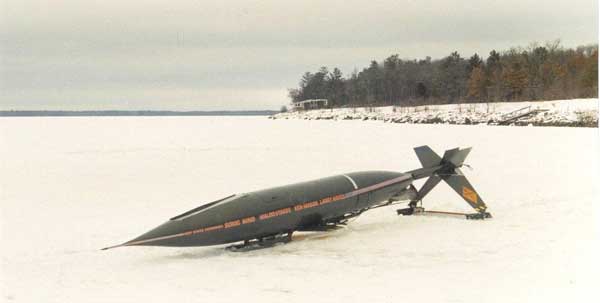 of a
commuter van I bought which we had removed the last couple of rows of
seats in order to install the rocket fuel tanks.We removed the bumper,
replacing it with a channel load structure that the engine was mounted
on. We would meet, set up the van, fuel and fire the engine and take our
data. Usually one step ahead of the police who always came to investigate
the sound of a "plane crash". One time I had to do some serious
song and dance in order to not spend time in the pokey. It is against
the law to fire rocket engines without a permit, did you know that?
of a
commuter van I bought which we had removed the last couple of rows of
seats in order to install the rocket fuel tanks.We removed the bumper,
replacing it with a channel load structure that the engine was mounted
on. We would meet, set up the van, fuel and fire the engine and take our
data. Usually one step ahead of the police who always came to investigate
the sound of a "plane crash". One time I had to do some serious
song and dance in order to not spend time in the pokey. It is against
the law to fire rocket engines without a permit, did you know that?
The entire vehicle was simplified, the fuel and oxidizer were stored in spherical tanks of stainless steel for the LOX and Titanium for the Ethanol (19 inches in diameter). The Helium pressure was also in slightly smaller diameter Titanium spheres originally used for satellites. Instead of expensive wheels we opted for blades similar to the type used on ice boats. Bill Sarns the famous ice boat builder built them and I modified them. Larry Hayes came on board as fabricator and built the steering (which is a series of bell cranks designed by Jeff Teaford) and the rear space frame section which is a pyramid of various diameter and wall thickness 4130 chrome moly tubing cradling a boom of mild steel. The boom holds a 3/4"staggered inverted V tail with the runners or blades mounted in 1/4"-4130 chromemoly plate chocks. The nose and roll cage are a monococque structure which came from my study of insects and their body strength. Pound per pound the Flea and the ant are the strongest animals on the planet. This is because of their well designed exoskeletons. I choose an aluminum cylinder wrapped with four wraps of ballistic fiberglass for the roll cage structure instead of a tubular space frame. This compartment was formed around the tip section of an F104 starfighter fuel tank. Lockheed had done all the aerodynamic shaping for this Mach 2 fuel tank and it has a Cd of .05! The ballistic wrapping was done by Protection Development International Corp. A company that builds Bomb baskets, bullet proof vests and armored cars. You can't shoot a .45 bullet through the driver's compartment as it is so strong. Pound for pound Sonic Wind is the most efficient and potentially fastest vehicle on Earth today.
Essentially Sonic Wind looks like a 24 foot long dart. The nose or cockpit
is Aluminum wrapped with ballistic fiberglass. Behind the driver are the
two spherical fuel tanks. Keeping the fuels in spheres as opposed to cylinders
keeps the sloshing distance small. So there is little Cg change created
by the fuel during a run. The Cg is always ahead of the Cp. Behind the
fuel tanks also in a spherical Titanium tank is the Helium pressure gas.
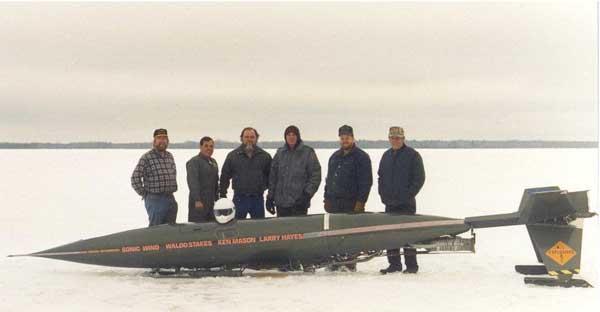 These
tanks are cradled in the Larry Hayes designed space frame. which terminates
in a 1/4 inch wall, 2"x2" boom. On the underside of the boom
mounted at 90 degrees from each other are two fins holding the rear runners.
Sonic Wind is built from all these different materials in order to minimize
and deaden frequency vibration. Two smaller fins are mounted on the top
of the larger fins near the root creating an X tail. Because the main
fins are mounted under the boom all the drag pull from the tail section
is felt on the rear underside of the vehicle. This stabilizes and also
generates negative lift. Sonic Wind is always trying to fly through it's
running surface. There are also two dialable horizontal canards at the
Cg. just behind the cockpit. Two reefed supersonic 7 foot diameter parachutes
do the high speed stopping. A hydraulically powered toothed brake carved
from a bulldozer blade, mounted between the runners hauls it to a stop.
Sonic Wind Holds 30 gallons of propellant which is enough for a 22 second
duration burn of 2,200 lbs.of thrust. it has a total Cd of .09, (sub sonic)
a total frontal area of 2.8 square feet and weighs 480 lbs. empty. it
burns 10 lbs. of fuel per second trading the fuel weight off for drag
during the run. Total drag at the speed of sound is 700 lbs. Acceleration
is 2.6 Gs average for 22 seconds. Friction from the blades on ice is negligible.
All this equates to a top speed of 1,000 m.p.h. plus.
These
tanks are cradled in the Larry Hayes designed space frame. which terminates
in a 1/4 inch wall, 2"x2" boom. On the underside of the boom
mounted at 90 degrees from each other are two fins holding the rear runners.
Sonic Wind is built from all these different materials in order to minimize
and deaden frequency vibration. Two smaller fins are mounted on the top
of the larger fins near the root creating an X tail. Because the main
fins are mounted under the boom all the drag pull from the tail section
is felt on the rear underside of the vehicle. This stabilizes and also
generates negative lift. Sonic Wind is always trying to fly through it's
running surface. There are also two dialable horizontal canards at the
Cg. just behind the cockpit. Two reefed supersonic 7 foot diameter parachutes
do the high speed stopping. A hydraulically powered toothed brake carved
from a bulldozer blade, mounted between the runners hauls it to a stop.
Sonic Wind Holds 30 gallons of propellant which is enough for a 22 second
duration burn of 2,200 lbs.of thrust. it has a total Cd of .09, (sub sonic)
a total frontal area of 2.8 square feet and weighs 480 lbs. empty. it
burns 10 lbs. of fuel per second trading the fuel weight off for drag
during the run. Total drag at the speed of sound is 700 lbs. Acceleration
is 2.6 Gs average for 22 seconds. Friction from the blades on ice is negligible.
All this equates to a top speed of 1,000 m.p.h. plus.
We took Sonic Wind up to Castle Rock Lake in Wisconsin in 1998. The weather got warmer when we arrived and we stayed for a week waiting for better lake conditions. It didn't happen so we got drunk and went home. In 2000 we took her up to Lake George New York where there was a better lake. When we arrived it was 50 degrees and raining. The lake was deteriorating by the minute, we stayed for a week, it just got worse and we left. For the last few years we have been focusing on Constitution LSRV as we are getting older and want to build this vehicle while we can. Sonic Wind can be ready for a go at the ice record (247 m.p.h.) and on beyond the sound barrier any time we can raise the money. We think we have found a better venue in Canyon Ferry Lake, Montana. It is 28 miles long, 5 miles wide and freezes as flat as a billiard table. When we researched it in January 2004 the air temperature without the wind chill was -36 degrees F......Waldo

