History in the Construction of the Constitution LSRV
The LR-99 rocket engine will be mounted into a triangulated tubular structure fabricated of 6" diameter stainless steel tubing. The chassis will serve double duty as fuel tank holding the Aqueous Ethanol. It will cradle the 10' long by 24" diameter LOX tank and the various diameter Titanium pressure vessels which will be bolted into the chassis for added rigidity .If the chassis should crack during a run. Pressure will be lost and the engine will shut down immediately while venting the alcohol from the crack. The chassis tubes are formed so that in the event of a premature shutdown the fuel will flow forward and down to stabilize and anchor the nose of the vehicle to the ground while assuring that the center of gravity of the vehicle is forward of the center of pressure. The LOX tank is aft so that as LOX is used the center of gravity of the vehicle moves forward. The pressure ant spheres keep the Helium (used to blow the propellants into the engine) from moving as little as possible.
The driver compartment and roll cage area is in
the nose ahead the front wheels and potential fire hazards. Visibility
is better but the vehicle will have an overkill of stability in order
for the driver to tell what the vehicle is doing in order to maintain
control. This is accomplished by making the finnage at the rear of the
vehicle slightly larger than actually needed. The roll cage will be built
from 3" diameter 1/4" wall stainless 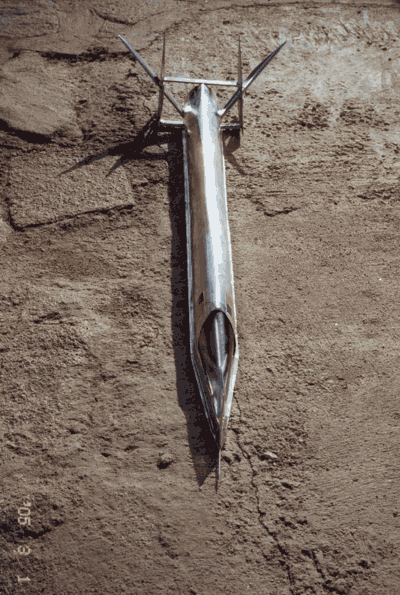 tubing
using mostly straight sections for added rigidity. The driver is in a
semi reclined position in order to better withstand G loads without redding
or blacking out.
tubing
using mostly straight sections for added rigidity. The driver is in a
semi reclined position in order to better withstand G loads without redding
or blacking out.
I envision controls to be simplified to an arming
switch and a firing pedal that arms the braking parachutes at the time
of ignition. A semi circle steering wheel will be used as the ten o'clock
and two o'clock hand positions are always the most used and comfortable
when American drivers are under stress. A simple green "Go"
or red "No go" light will be given from an onboard computer
if all pressures are dialed up and stable before ignition. There is no
need for gauges and needles to watch as all the driver's attention should
be focused on the run itself. If there is an anomaly the onboard computer
will shut the engine down, vent the fuel and deploy the first parachute.
The chute system will consist of two reefed 17 foot diameter super sonic
parachutes and an air brake at the rear of the vehicle. Manual deployment
of the parachutes will be by pushing the firing pedal beyond the engine
firing position with the secondary chute fired by a lanyard attached to
the driver's wrist. Any time the chutes are deployed the computer will
shut the engine down first, vent fuel and than proceed with chute deployment.
All other data will be recorded by a redundant computer system to rule
out anomalies. The driver will sit behind a 1/2" thick Polycarbonate
windscreen which also acts as cockpit door for entry. It is entirely removed
for access and has no hinges. The skin of the vehicle is made from lapped
upward 6" wide strips of stainless steel (lapped 1" over each
lower strip) stretched and welded to the chassis at each end. The strips
are lapped similar to a roofing shingle and will be able to be expanded
under internal pressure. Certain areas of the underside of the vehicle
will have a mesh skin in order to let air underneath the car pass through
to the skin. Essentially the skin will breath to equalize internal air
pressure to external air pressure. This will prevent a blow over should
air build up under the car. By putting the skin strips under tension along
the length of the car and welding them to the chassis. A never before
strength of chassis and body will be achieved as all the skin will be
under tension in one direction. This will make it much more rigid than
a riveted skin or composite. The lapped edges running front to back will
also control air flow at the boundary layer. The strips will be scratched
from front to back with heavy sandpaper. This will create microscopic
grooves in the skin strips along their entire length. These grooves will
vacuum in air molecules helping keep the skin boundary layer air laminar.
Research on this was done in the early 1980s at Langley. Constitution
LSRV is a ground effects vehicle that because of it's triangular frontal
aspect, takes all oncoming air and splits it into two sheets on either
side, above the vehicle. No air is allowed under the vehicle at the nose
and none can slip under the vehicle because there is a 2" wide boundary
layer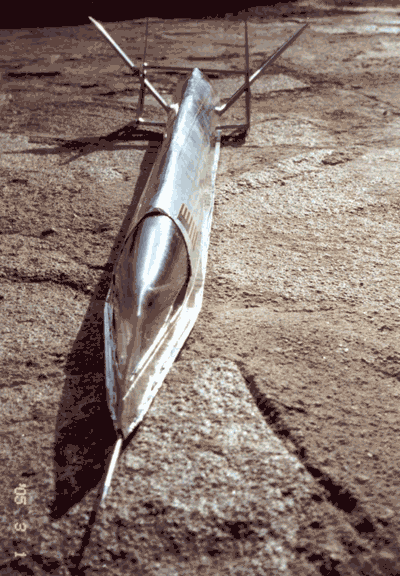 lip
that runs horizontally along both sides the entire length of the vehicle
at it's base. These two controlled sheets of air and shock are essentially
on top of the vehicle. So all air that strikes the vehicle becomes used
for negative lift and directional stability. This vehicle is designed
to perform best in the supersonic regime as the shock waves created by
the air are directed up and away on either side of the vehicle and anchor
it to the running surface. It doesn't matter where the shocks move to
along the body they will always perform this duty, keeping the nose down
and keeping the vehicle moving in a straight line. The rear wheels are
contained in solid aluminum carved spats that are triangulated so that
all leading edge shocks generate negative lift over the wheels. There
are two 60 degree swept back, 45 degree swept up stabilizers at the rear
of the vehicle. They pass through the large diameter rear wheels and generate
shocks that press against the running surface stabilizing the vehicle
in roll and yaw. They will make shock that acts as an invisible lever
without any return moment to destabilize the vehicle such as wide tracked
rear wheels do. The rear stabilizers are made wider as they extend outward
so that the supersonic footprint created by them is uniform along their
length.
lip
that runs horizontally along both sides the entire length of the vehicle
at it's base. These two controlled sheets of air and shock are essentially
on top of the vehicle. So all air that strikes the vehicle becomes used
for negative lift and directional stability. This vehicle is designed
to perform best in the supersonic regime as the shock waves created by
the air are directed up and away on either side of the vehicle and anchor
it to the running surface. It doesn't matter where the shocks move to
along the body they will always perform this duty, keeping the nose down
and keeping the vehicle moving in a straight line. The rear wheels are
contained in solid aluminum carved spats that are triangulated so that
all leading edge shocks generate negative lift over the wheels. There
are two 60 degree swept back, 45 degree swept up stabilizers at the rear
of the vehicle. They pass through the large diameter rear wheels and generate
shocks that press against the running surface stabilizing the vehicle
in roll and yaw. They will make shock that acts as an invisible lever
without any return moment to destabilize the vehicle such as wide tracked
rear wheels do. The rear stabilizers are made wider as they extend outward
so that the supersonic footprint created by them is uniform along their
length.
lip
that runs horizontally along both sides the entire length of the vehicle
at it's base. These two controlled sheets of air and shock are essentially
on top of the vehicle. So all air that strikes the vehicle becomes used
for negative lift and directional stability. This vehicle is designed
to perform best in the supersonic regime as the shock waves created by
the air are directed up and away on either side of the vehicle and anchor
it to the running surface. It doesn't matter where the shocks move to
along the body they will always perform this duty, keeping the nose down
and keeping the vehicle moving in a straight line. The rear wheels are
contained in solid aluminum carved spats that are triangulated so that
all leading edge shocks generate negative lift over the wheels. There
are two 60 degree swept back, 45 degree swept up stabilizers at the rear
of the vehicle. They pass through the large diameter rear wheels and generate
shocks that press against the running surface stabilizing the vehicle
in roll and yaw. They will make shock that acts as an invisible lever
without any return moment to destabilize the vehicle such as wide tracked
rear wheels do. The rear stabilizers are made wider as they extend outward
so that the supersonic footprint created by them is uniform along their
length.